Reminders from Longtime Grain Storage Specialist In Setting the Stage for a Successful Experience 
Storing sunflower seeds this fall and into the winter could call for some modified management practices, depending on one’s local weather patterns prior to and during the harvest season.
That’s a reminder from Ken Hellevang, longtime grain storage specialist and now professor emeritus of agricultural engineering at North Dakota State University.
There are a couple components at play here, Hellevang says. First, “if we’re harvesting earlier than normal, we’re going to be harvesting at warmer temperatures — and there’s potential for the sunflower to hit a lower moisture content than what we may desire,” he notes. “In our northern climate, that typically is not an issue.” (One prime example was back in 2019, when the opposite conditions occurred: a very wet, delayed harvest in the Northern Plains.) “But as we go into warmer and drier climates, we can have sunflower ending up with a 6% harvest moisture rather than even 7 or 8%.”
Such low moisture content then becomes concerning from two perspectives, Hellevang points out. “One, of course, is that the pounds we have to market is affected by the moisture content. The drier they get, the fewer pounds to sell.” Secondly, the lower the seed moisture content, the more shatter loss during combining and the higher level of foreign material, including ‘fines,’ ending up in stored seeds. Fines will restrict storage bin airflow, Hellevang reminds, limiting aeration’s cooling effect — especially toward the bin center.
So if the farmer will be storing sunflower following harvest, and doing so at warmer-than-normal temperatures, “it becomes more critical — even if we’re at that 7-8% moisture — to cool the sunflower as quickly as we can,” Hellevang states.
“I go with the ‘rule of thumb’ that for every 10 degrees that we cool stored grains, we roughly double the storage life,’ ” the retired NDSU ag engineer observes. “So even though it might be warm during the day, if we have cool nights we probably need to be running the aeration fans, trying to cool down the grain as quickly as we can to enhance the storage life.”
Though Hellevang’s recommendations allow for long-term storage (through the winter months) at 10% moisture, he prefers a 7-8% level for seeds held in storage during warmer weeks and months. One reason why is the higher average oil content of today’s sunflower hybrids. “The higher the oil, the lower the moisture content needs to be,” he says. “It’s not a big change (from recommendations a couple decades ago); but if you look back to the initial research, they (NDSU ag engineers) came up with the recommended moisture contents of 10% for confection seeds and 8% for oilseeds. And the difference, of course, was due to the oil content of the two types.
“As we’ve seen the average oil content increase, we really need to be thinking of reducing the storage moisture content,” he continues. “Not a lot. But I do think we want a 7-8% moisture rather than over 8% for storage of oil sunflower during warm temperatures.”
Temperature cables are commonplace in today’s larger bins, and Hellevang is a strong supporter of their use — with certain qualifications. “Without the cables, we really don’t know what the temperature profile is in a storage, what is happening in there.
“But, grain is a good insulator. So in reality, if you get, say, four feet away from that temperature cable and end up with a hot spot, it will take a long time before the problem is large enough to where it will show up on the sensors.”
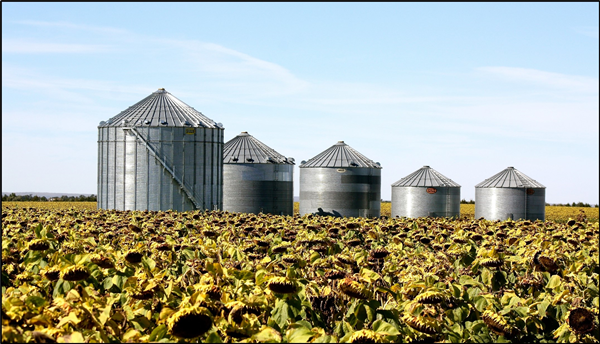 Having multiple temperature cables obviously helps — especially in today’s larger storage bins. Along with a cable in the middle, “I recommend one near the south side of the bin, since we get a fair amount of solar heat gain there,” Hellevang says. Another location would be on the bin’s north side, perhaps two to three feet from the wall.
It may not be practical to install enough cables to really understand the entire story of what’s happening inside a 50,000-bu bin or larger, he affirms. “But certainly more than one cable would be encouraged.”
While very helpful, temperature cables aren’t the total answer to maintaining grain quality in storage, Hellevang states. Nor are the control systems available on today’s market. “You might be sensing the outdoor temperature and relative humidity — and, with a microprocessor, calculate when you should be running the fan. That’s a nice tool; but again, we can’t rely totally on it. Most of the relative humidity gauges tend to drift; they’re not always accurate.”
So, the bottom line, says the veteran ag engineer, is this: utilize the available technology — but don’t neglect your hands-on monitoring and management. “I’ve always spent a lot of time stressing the basic fundamentals,” Hellevang states. “Each year is different. So if we understand the fundamentals of storage management, we can then adjust for whatever a particular year is throwing at us.
“Understanding about cooling the grain, its benefits, the typical moisture contents we deal with . . . those are still the key things that are going to help us be successful.” — Don Lilleboe