Central North Dakota Grower Mason Wede Has Operated His Drone Business Since 2023
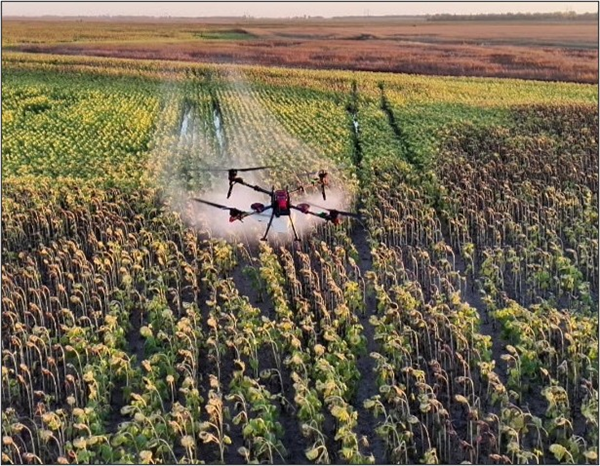 Photo courtesy of Mason Wede
Drones are taking over the air across agricultural lands to apply products in an efficient and environmentally friendly show.
Mason Wede started his own drone application business, NoDak Drones, in 2023. Wede’s background in farming and his college degree in computers have lent their hand in helping him bring drone spraying technology to farming for his family and customers.
A third-generation farmer from Carrington, N.D., Wede’s drone spraying business covers fields in North Dakota, South Dakota and Minnesota — and it’s only growing. The evolution of drone usage has increased dramatically, especially in North Dakota. As of 2021, Wede estimates, there were only a couple drone operators in the state of North Dakota; but now that number has grown past 200.
As far as sunflower goes, Wede says he offers varied services to farmers. “We offer fungicide, insecticide, desiccation, herbicide and pre-emerge application,” he remarks. Wede raises sunflower himself, as well as corn and soybeans, so he’s seen the positive impacts of utilizing drone application on his own operation. He says a little less than a quarter of his customers use his drone services for their sunflower fields.
Compared to more-traditional spraying methods, Wede admits that drone application is still a relatively new industry; but drones have the same capabilities as any other aerial application unit. “We’re still waiting for the research to catch up, and there are still new models coming out every year.”
One of the benefits that Wede has noticed is that drones do an excellent job spraying down under the canopy for better overall coverage. This precision reduces over-application, lowers costs and ensures the even distribution of product.
Other benefits include enhanced harvest efficiency. Drones can be used to speed up the harvest process via desiccation, with the treated sunflower reaching harvest readiness 5-10 days sooner.
The application for insecticide and fungicide has yielded good results on his own sunflower for Wede. “The first year when I was utilizing drones on sunflower, we didn’t apply any insecticide, and we couldn’t find any bug pressure. We went out and sprayed for bugs this year after we saw some bug pressure, and we can’t find any, so we know that it works. There’s good coverage using precision application techniques”.
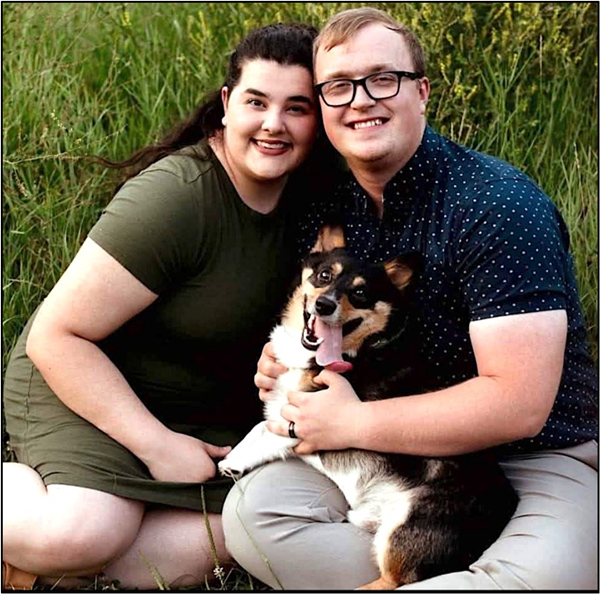 Mason & Alexandra Wede (& Winston)
Compared to traditional spraying methods, drone usage can increase efficiency, according to Wede. “With my operation, if it’s cropland with no obstacles, I can probably get about 45-50 acres an hour with my bigger unit. It really depends on the drone, and there are bigger units on the market compared to when I first got started.”
Farmers are witnessing the benefits of incorporating drone spraying technology into their farming practices and operation. Wede emphasizes. “We hear about the future of technology in agriculture. Even my dad was skeptical of technology, but it’s been very eye opening to see it in practice revolutionizing ag. It’s actually sticking — and there are people who use these drones in their daily operation.
“It’s going to be a fixture in agricultural communities for the foreseeable future.” — Cierra Hauck