| Kansan Pam Rogers Truly Enjoys Sunflower — Both As a Profitable Crop & As a Vehicle to Put Smiles on Her Community’s Faces |
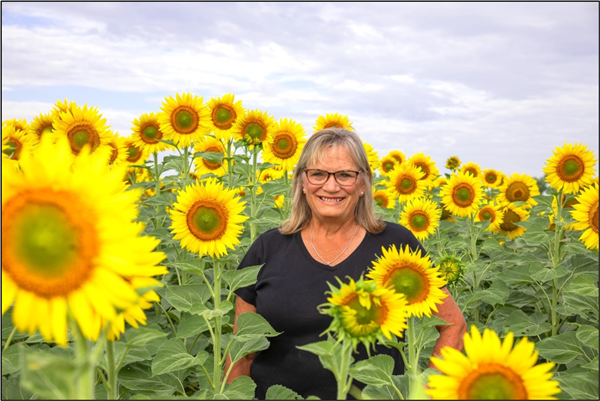 |
Pam Rogers doesn’t grow many acres of sunflower, but she gains income from the crop in two ways. First, of course, by marketing the harvested seeds. But before then, by hosting visitors to her field. And, although she can’t put a price tag on it, she gains a lot of pleasure from sharing her joy with the crop.
Rogers, whose farm is just west of Kansas’ largest city, Wichita, began her sunflower sojourn in 2020. Her family farm had a small 10-acre field open to experimentation that year. At the time, her father, Lynn Buerki, was still an active farmer at age 88. After her mother passed in 2012, Pam had become her dad’s “right-hand man” and full-time farm employee. Standard crops on the farm included wheat, milo, soybeans, brome and alfalfa.
When, in the spring of 2020, her father asked what she thought should be planted in that small field, Pam quickly suggested sunflower. Pam began researching the crop by contacting family friend Cameron Peirce of Hutchinson, a veteran sunflower producer and current member of the National Sunflower Association Board of Directors. “He was more than happy to share with me what I needed to do to get started,” Pam recalls. But, she lost the vote that spring to her dad and brother, both of whom opted for soybeans.
Unfortunately, Lynn passed away that June of 2020. Still hooked on sunflower, Pam, now a third-generation farmer, planted her first sunflower crop of 10 acres in May 2021. She increased the ’flower acreage to 40 the following year. The 2026 season was her sixth, with 20 acres of sunflower on the farm this year.
“In the second year of planting sunflower, those acres were planted back to wheat in the fall. The next harvest, I had an increase of 10-12 bushels an acre of wheat following the ’flowers,” she reports. “The field was adjacent to wheat that did not have ’flowers. So I definitely saw the benefit of sunflower in the rotation.”
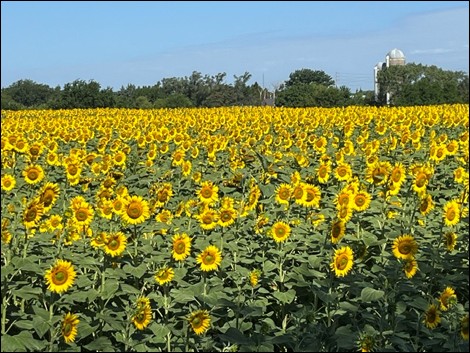
Each year, Pam has opened her sunflower field to the community to walk through, take photos “and enjoy the beauty of sunflower.” Visitors have run the gamut from a marriage proposal event, baby announcements and a wedding anniversary celebration, to a Native American in full dress for photos, photos of newborns, school kids, guided field tours — and numerous professional photographers.
Once she witnessed the degree of interest from outside visitors that first year, Pam set up a donation box the second season. “My goal was to pay for the seed, fertilizer and pre-emergence herbicide,” she notes. “The donations covered my expenses!”
Public interest and agritourism “has increased tremendously” since then, Pam affirms. “I still have a donation box available, but I now charge a set fee for the professional photographers, who have anywhere from four to six sessions an evening.”
Pam opens the field from 6:00 to 9:00 p.m. for two weeks during the optimal bloom period. “My husband and I are at the field each evening to answer questions about the crop and to educate the visitors about sunflower,” she says.
“I have great joy in sharing about agriculture and our farming operation with others,” Pam concludes. And yes, the presence of sunflower definitely has become a key part of that enjoyment equation. — Don Lilleboe