NSA Board Member Recounts Experience of Being Nearly Buried Alive in Binned Sunflower Seeds
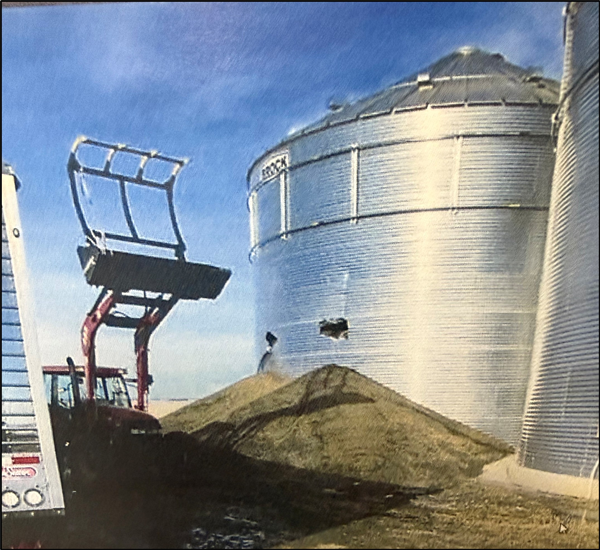 |
Shannon Depoy’s father, Perry, saved him by ramming a loader tractor into the side of this sunflower-filled grain bin in February of 2017.
|
All Shannon DePoy ever wanted to do was farm.
“I graduated high school in 1993, and I had the chance to either drive truck or go to college,” he recalls. “I hated school, so I drove truck and didn’t go to college.”
He’s been working on his family farm just outside Lantry, S.D., ever since.
“Now I’m kind of the main guy,” Shannon says.
At age 87, his dad, Perry, still works on the farm with Shannon. “He’s in really good shape,” Shannon affirms. “He’s never had a broken bone or a joint replacement. He’s very active for an 87-year-old.”
Together they farm about 15,000 acres in west central South Dakota. Winter wheat, spring wheat, corn and sunflower are regular crops in their rotation. They’ve also tried soybeans the past couple of years; Shannon says this year’s lack of rain has taken a toll on the soybean crop.
Sunflower, on the other hand, has been a consistent money-maker for the DePoys. They added ’flowers to their rotation in the mid-1990s, replacing what would have been summer fallow fields.
“We liked them because we could plant them with our air seeder,” Shannon notes. “And we got to use our combines a little more, instead of just in the summer. And we spread out the workload a little. I do think adding sunflower into the rotation helped us grow better spring wheat. The ’flowers just kept things a little cleaner.”
In 2016 the DePoys grew one of their best oilseed sunflower crops ever. They built two new 50,000-bushel bins to store the seeds.
“It was the first crop we ever stored in those bins,” Shannon recalls.
It’s a crop he’ll never forget; because it also nearly killed him.
On February 14, 2017, Shannon, his dad and two hired men checked on the bins, both filled with sunflower.
“We could see some ice drifting off the top. I climbed up there with our two hired men,” he reflects. “It was pretty hot in the bin. I wanted to get them cooled off and start hauling them.”
Shannon hoped getting the ’flowers out of the center of the bin would help. They ran the fan for a bit; but when it quit, Shannon decided to go in and loosen the seeds himself. He put on a harness, tied it to a rope before entering the bin and walked around the edge. That’s when the seeds caved in on him.
“I remember falling waist deep in ’flowers and then they covered me up. I was conscious for quite a while,” he says. He felt his cell phone vibrating in his pocket; his wife had tried calling, but he couldn’t answer.
“It was Valentine’s Day,” Shannon says. “We hadn’t really talked about it, but I figured I’d pick up some flowers for her, and we’d go out for dinner.”
Shannon stayed awake for about 30 minutes. He could hear his dad and hired men trying to get him out of the bin.
“I wasn’t really worried as long as I could hear the guys,” he recounts. “But I could feel myself sinking. And I remember being relieved when they shut the auger off because I know what happens when you go through an auger.
“But then it got really quiet — and that was scary. Dad and the guys took shovels to find where the rope went into the seeds.”
They couldn’t reach Shannon, so Perry used a six-foot soil moisture probe to search for his son.
Shannon says the next thing he remembers is hearing the tractor start outside. They hooked the rope to the tractor and Perry tried pulling Shannon out. That didn’t work, and by then Shannon was starting to lose consciousness.
“Things were starting to get a little fuzzy,” he says.
The hired men had called 911, but being 25 miles from town, in a very rural part of the state, they knew it would be a while before help arrived. Cheyenne River Police Officer Milo Lafferty, who was patrolling nearby, heard the call and was the first to arrive on the scene.
Perry had a new plan. He started up the loader tractor and rammed the loader into the side of the bin. When he struck the bin at the right angle, seeds began spilling out.
Once some seeds were out of the bin, the rope became visible. Lafferty followed the rope to Shannon, 10 feet down.
“I remember he brushed me off and I exhaled. He said that was a good sign,” Shannon recalls.
Shannon’s dust mask was still on his face. He thinks that’s part of what saved him.
“I’m so grateful I had that mask on and that it stayed on my face,” he now says. “I felt so bad that Dad destroyed the grain bin. He insisted he didn’t care about the grain bin. A grain bin can be replaced, but a person can’t be. He saved my life.”
Shannon was transported by ambulance to Eagle Butte and then airlifted to a Rapid City hospital. He spent several days in the hospital, and recalls being released just in time to see his son’s basketball game in Rapid City. The family went to a car show, too, desperate for some normalcy after such a traumatic, scary week.
“I remember I got really tired walking around the car show, so they got me a wheelchair,” Shannon says. “We stayed in Rapid City that night, and I woke in the middle of the night pouring sweat — and my right hand was stuck in a fist, like I’d had a stroke.”
Shannon and his wife rushed to the emergency room, where Shannon quickly lost his vision. Doctors thought either a portion of Shannon’s brain had been deprived of oxygen for so long it killed some of the cells that control vision, or a piece of cartilage had come loose and was causing his vision loss.
Whatever the cause, losing his vision was perhaps the scariest part of the whole incident for Shannon.
“That scared me because I know quite a few farmers who have lost arms or fingers or stuff like that. You can still work like that, but if I lost my vision what would I be able to do on the farm?”
Shannon was transferred to a rehab center in Omaha, Neb. There, his vision slowly returned, first the peripheral, then the full vision. He spent two and a half weeks in Omaha and, for the next few months, continued therapy twice a week in Spearfish, S.D.
Nearly 10 years later, there are still some reminders of what he went through. Shannon wears reading glasses now, and his handwriting isn’t nearly as legible as it was prior to the accident. But those, he says, are minor inconveniences when he thinks about how things could have gone.
“I’m just so happy to have my vision back, because what can you do as a farmer without eyes?”
In 2023, Shannon was appointed to the boards of the South Dakota Oilseeds Council and the National Sunflower Association. He hopes those positions might help him remind farmers around the country just how quickly accidents can happen.
“It’s a good reminder to be careful. You get busy during harvest and there’s always something going on and we’re always busy,” he affirms. “I don’t want fame and fortune. I just want to share my story and maybe help save someone else’s life.” — Jody Kerzman