By Mike Krueger*
World geopolitical events have dominated the markets all summer, and it appears none of that will change anytime soon. The U.S./Iran war is not resolved, and the off-and-on attacks followed by rumors a “deal” is near have kept the markets volatile.
Soybean oil and corn futures markets rally when crude oil rallies and decline when crude oil declines. The problem is that no can predict what the next “war rumor” might be or, more importantly, when President Trump finally runs out of patience with endless negotiations.
The Russia/Ukraine war also intensified during the summer. Ukraine is attacking vessels and export facilities deeper into Russia every week. The Sea of Azov is a major shipping channel for Russian wheat exports. As much as 25% of Russia’s exports move through the Sea of Azov and into the Black Sea. Ukraine drone strikes have penetrated across the Sea of Azov, and shipping has come to a virtual standstill. That caused a significant wheat rally.
Both Russia and Ukraine have intensified their attacks on grain export facilities in the Black Sea, causing significant damage. Recently, Russia attacked Ukraine export locations on the Danube River. Shipping lanes can be reopened quickly. It can take a long time to repair or replace damaged export elevators.
The problem is that none of these wheat export disruptions have led to increased export sales of U.S. wheat. That is the bearish wheat market factor.
There are two more major world ocean freight choke points that can cause considerable disruptions. The Houthis from Yemen continue to cause delays and damage in the Red Sea and Suez Canal. Dry conditions in Panama and Central America are threatening to create reduced draft conditions in the Panama Canal. These issues lead to higher voyage times and higher ocean freight rates.
There have also been some Northern Hemisphere weather problems that have taken the edge off yields. Much of western Europe, especially France, has been in the grip of a severe mid- to late-summer drought. Wheat yields look to be down 10% to 20%, but corn and other feed grain yields were hurt much more. News channels were full of stories with pictures of burning vineyards in the Burgundy region of France.
U.S. weather was nearly perfect the first half of the growing season, but turned hot and dry across most of the Northern Plains, plus parts of the western Corn Belt, starting in early July. The USDA did trim the corn yield forecast in their August estimates. They also reduced the soybean yield slightly.
These yield reductions were offset by major increases in corn and soybean harvested acreage estimates. Corn harvested acres were increased 1.2 million from the June 30 estimate. Soybean acres were increased 1.4 million. Those are significant increases over just a 30-day period and left analysts trying to figure out where the “extra” acres came from.
The 1.4-million-acre increase in soybean harvested acres added about 70 million bushels to soybean production. Soybean ending stocks would have dropped from 320 million bushels all the way down to 250 million bushels. That is a bin-bottom level.
The accompanying map shows the soil moisture anomaly for the U.S. for the month of July.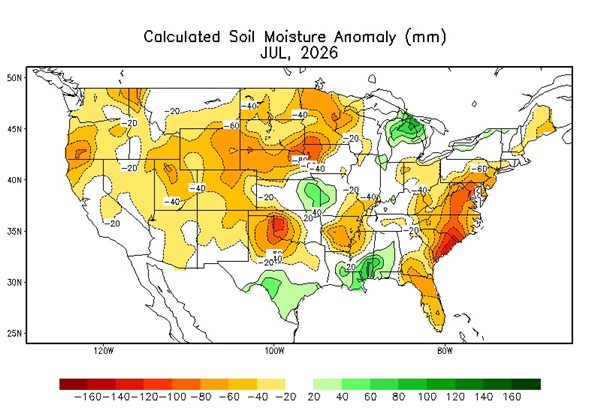
The high-oleic sunflower market has been strong as well. Prices per hundredweight are up as much as $2.50. The oil premium is an additional $2.00/cwt for each one percent of oil over 40%. Unlike corn wheat and soybeans, the USDA does not publish weekly crop ratings for sunflower, but some individual states do. The North Dakota crop was rated 40% good to excellent as of mid-August, but these ratings will continue to slip without rain.
Volatility in all of the markets will likely continue well into the fall. There is no reason today to expect the wars in Iran and the Black Sea region will end any time soon. Cease fires never seem to hold. Crude oil flows through the Strait of Hormuz are still severely impeded. Both Russia and Ukraine have increased attacks on export facilities and shipping.
Another potential major factor in Southern Hemisphere crop production is the development of a “Super El Nino” weather event. It could be one of the strongest El Ninos on record. El Nino patterns typically mean significant drought and yield reductions across Australia and Argentina. So far, weather in Australia has been exactly the opposite with plentiful rainfall. September and October are the critical months for wheat development in Australia.
* Mike Krueger founded The Money Farm, and is now a senior analyst with World Perspectives, a Washington, D.C.-based consulting company. While the information in this article is believed to be reliable, marketing involves risk, and the author and The Sunflower assume no responsibility for its use.