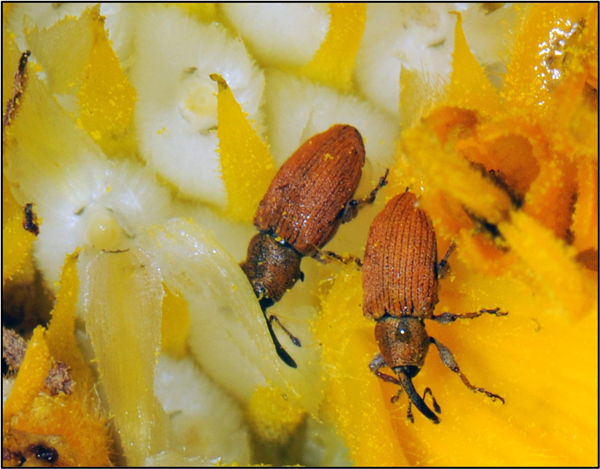
 Photo: Patrick Beauzay / NDSU Entomology Department
After showing up in incredible numbers in 2023 and 2024, the red sunflower seed weevil (RSSW) backed off somewhat in 2025 across the central South Dakota sunflower belt. But the insect still inflicted significant damage to numerous fields, impacting yield and quality and slicing grower revenue.
The 2023 story was an especially ugly one, with some incredibly high RSSW populations. Damage was exacerbated by the seed weevil’s increased resistance to the pyrethroid class of insecticides that had served as primary management weapons for several years. That, coupled with the previous loss of chlorpyrifos (i.e., Lorsban and generics) to a court decision, “opened the door” for RSSW depredation in the region.
The 2024 season didn’t prove too much better for central South Dakota. Observed seed weevil populations were as high as 500 per plant. The problem, not surprisingly, had a definite impact on acreage, as South Dakota farmers planted just 230,000 acres of sunflower in 2024. That compared to 495,000 in 2023 and an average of 587,000 during the 2017-2022 five-year period. (The state’s sunflower acreage jumped back up to 430,000 in 2025, according to USDA.)
Fortunately, South Dakota seed weevil populations declined in 2025. “This reduction was attributed to two weeks of sub-zero temperatures that occurred in the absence of snow cover,” says Adam Varenhorst, associate professor and extension field crop entomologist with South Dakota State University. However, Varenhorst adds, “these populations still exceeded the [economic] thresholds by more than approximately 10x.” Still, that was a dramatic improvement over previous couple years when thresholds were exceeded by 100x all the way up to 1,000x.
The conundrum remains, however: pyrethroid insecticides are still ineffective for management of the red sunflower seed weevil. “Continued use of these products is not recommended in South Dakota,” Varenhorst emphasizes. On a positive note, malathion has been reported to work well for numerous producers. However, SDSU entomologists did receive reports of malathion failures during 2025, and they will be further investigating those reports this year.
Along with the malathion evaluations, the SDSU entomology group also will be evaluating non-insecticidal management approaches for RSSW in 2026.
So what is the bottom line on seed weevil management recommendations this season in South Dakota? Varenhorst stresses the following points:
• The pyrethroid class of insecticide products should not be used for management of red sunflower seed weevil populations.
• For malathion, there is only one rate listed on the 24(c) product labels, and it is critical that applications are made using that rate.
• It is recommended that sunflower be planted as early as possible, as research has demonstrated that planting during the first or second week of May can greatly reduce red seed weevil infestations. June-planted sunflower generally has much high seed weevil infestations.
Fortunately, North Dakota has not suffered nearly as badly from the red sunflower seed weevil in recent years compared to South Dakota. According to the North Dakota IPM Crop Survey, 2025 seed weevil densities ranged from 0 to 51 weevils per sunflower head, with an average of just three weevils per head across all fields during flowering. That was slightly lower than the 2024 level of infestation. “The highest populations were concentrated in southwestern North Dakota,” reports Janet Knodel, North Dakota State University professor and extension entomologist. “Most other production areas experienced lower pressure.”
The NDSU-established economic threshold for oil-type sunflower in 2025 was any level above seven weevils per head. Knodel says about 6% of the fields surveyed during flowering came in above the threshold and required treatment.
North Dakota sunflower growers have been extremely fortunate compared to their South Dakota counterparts, in that RSSW resistance to the pyrethroids has been very limited thus far in the state. Most North Dakota growers relied on labeled pyrethroids in 2025, and control was generally acceptable.
However, “we did identify several fields in southwest North Dakota where control was disappointing — especially in fields with high weevil numbers,” Knodel relates. “Our lab bioassay suggests we are starting to see reduced susceptibility to some pyrethroids in that area. This does not mean pyrethroids have failed statewide; but it is an early warning sign.
“In 2025, RSSW bioassays for pyrethroid resistance found that RSSW from a field near Carson (Grant County, south central North Dakota) had reduced susceptibility to deltamethrin and lambda-cyhalothrin, but good efficacy of esfenvalerate and beta-cyfluthrin,” Knodel adds. “This pattern suggests a reduced susceptibility or early stage resistance development.” A similar progression was previously documented in central South Dakota, where reduced performance first occurred with deltamethrin and lambda-cyhalothrin before spreading to other pyrethroids.
“If you experienced high weevil numbers or poor control, please get in touch with us before weevil spraying,” Knodel asks of North Dakota growers. “We want to collect live weevils from your field for pyrethroid resistance bioassay testing.” Her email address is janet.knodel@ndsu.edu.
 As to recommendations for North Dakota sunflower growers for 2026 management of the red sunflower seed weevil, Knodel emphasizes the following steps employing IPM tactics:
• Scout, don’t assume. Monitor fields (two or more times per week) for weevils from late R4 through the R5.7 stage. Do not spray automatically — use the economic threshold to guide decisions.
• Use the correct rate. If populations are above the threshold, use the high-labeled rate to improve knockdown and mortality and reduce the risk of insecticide resistance development.
• Adjust planting date when possible. Planting before June 1 and using earlier-maturing hybrids can help reduce exposure to peak egg-laying, reduce seed damage from weevils, and, in the long run, decrease populations to more manageable levels.
• Avoid repeated use of the same insecticide group or product. Rotate modes of action (or insecticide group). Avoid repeated use of the same active ingredient or product wherever resistance is suspected.
• Finally, Knodel advises that Isocycloseram (IRAC Group 30, meta-diamide) is now registered in the U.S. for several other crops. North Dakota field trials over the past three years have shown good to excellent efficacy against RSSW. “South Dakota has applied for a Section 18 Emergency Exemption for 2026. If approved by the EPA, North Dakota may pursue a similar request.
“A new mode of action would give growers a vital tool for resistance management,” the NDSU entomologist concludes. — Don Lilleboe