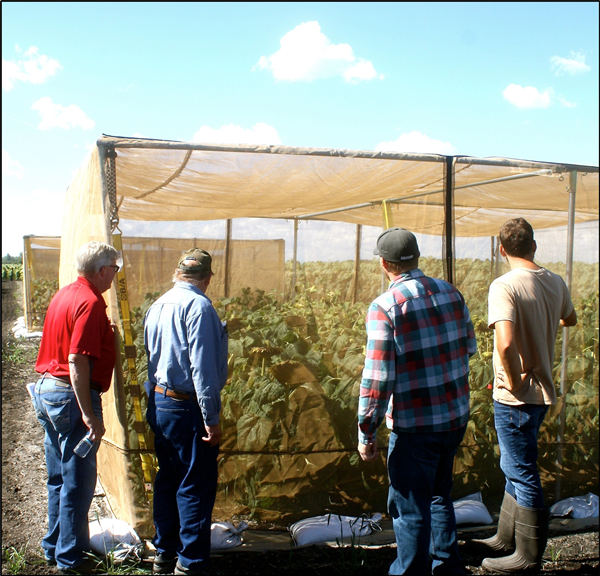
 Since its beginning, the National Sunflower Association has committed itself to providing funds to public researchers to stimulate new or continuing ongoing sunflower research that leads to disease- and pest-tolerant hybrids, better cropping practices and ways to reduce production costs.
This research is mainly funded with checkoff funds from Colorado, Kansas, Minnesota, and North and South Dakota. To increase the pool of financial resources, the sunflower industry also pitches in. The NSA Confection Committee contributes a portion of its funds to research projects. These funds come from sunflower industry members not included in the checkoff. In addition, the Manitoba Crop Alliance based in Canada also contributed funds to various projects this year.
The National Sunflower Association Board of Directors met in mid-February and approved just over $112,000 in research project funding for 2026. Below is the list of projects that were funded.
-- John Sandbakken, NSA Executive Director
Determination of Rust (Puccinia helianthi) Virulence in the Northern Great Plains
Principal Investigators: Sam Markell, Febina Mathew and Zachary Ittel, North Dakota State University, Brent Hulke, USDA-ARS, and Bob Harveson, University of Nebraska-Scottsbluff
Project Objectives: The objectives of this study are to determine the pathogen virulence (determine races) that occurs throughout the Northern and Central High Plains. That knowledge will inform breeders (and pathologists and geneticists) and seed companies as they develop and/or market successful hybrids. In addition, a new “differential set,” which adequately represents the known rust resistance genes, will be developed for use into the future. Lastly, a plant pathology graduate student will be educated as a sunflower pathologist. The sum of $9,000 was provided by the NSA Confection Promotion Committee and $3,184 by the Manitoba Crop Alliance for this project.
Funded Amount: $31,843
Insecticide Testing and Continued Screening for Pyrethroid-Resistant Red Sunflower Seed Weevil
Principal Investigators: Adam Varenhorst, Patrick Wagner, Philip Rozeboom and Bradley McManus, South Dakota State University, and Janet Knodel and Patrick Beauzay, North Dakota State University
Project Objectives: This project will evaluate the efficacy of currently labeled malathion for red sunflower seed weevil (RSSW) in South Dakota. The data generated from the efficacy trials will be utilized to obtain emergency registration for products that significantly reduce red sunflower seed weevil populations for the following growing season. The project will evaluate farmer field failures with pyrethroid insecticides for control of RSSWs to determine if pyrethroid-resistant RSSWs exist in North Dakota. RSSW adults will be collected from farmer problem fields near Hettinger and Linton in North Dakota and tested for resistance using commonly used pyrethroid active ingredients registered in sunflower. The NSA Confection Promotion Committee paid for this project in its entirety.
Funded Amount: $6,000
Red Sunflower Seed Weevil Phenology and Dispersal in South Dakota
Principal Investigators: Karl Roeder, Shannon Osborne and Sharon Schneider, USDA-ARS
Project Objectives: This project will provide information on red sunflower seed weevil (RSSW) phenology and dispersal that is critical to understanding the biology of this incredibly important pest of sunflower. Results from the first objective will provide novel data on when and how RSSW emerge, reproduce, and infest sunflower. Furthermore, detailed information on RSSW phenology will enable more-strategic application of control methods, chemical or cultural, to maximize effectiveness and reduce pest outbreaks. Results from the second objective will provide a first approximation of the potential and realized dispersal capabilities of RSSW, of which little to no information currently exists. Once the preliminary work in this proposal is completed, future on-farm research can be conducted to determine when and how far red sunflower seed weevils move across a typical sunflower-producing landscape, which is vital for any area-wide pest management program.
Funded Amount: $15,000
Spring Weed Burndown Options for Sunflower
Principal Investigator: Brian Jenks, North Dakota State University
Project Objectives: Evaluate crop tolerance and kochia control in sunflower with non-labeled burndown herbicides compared to current standards. This study will determine the effectiveness of non-labeled herbicides for preplant/pre-emergence kochia control. If these herbicides are effective and can be labeled, then they will provide farmers with another option to control glyphosate-resistant kochia prior to sunflower emergence. $1,000 was provided by the Manitoba Crop Alliance for this project.
Funded Amount: $10,000
Kochia Control with Combinations of Pre-Emergence Herbicides
Principal Investigators: Kirk Howatt, Brian Jenks and Caleb Dalley, North Dakota State University
Project Objectives: Kochia has been a persistent problem in North Dakota agriculture for decades. It is adapted to arid and semi-arid environments that include much of central and western North Dakota. Even in eastern North Dakota, with more-regular precipitation, kochia thrives in sandy soil textures where drainage readily removes excess soil moisture, which in turn results in generally dry surface soil conditions. This research will determine the most effective residual herbicide that does not require mechanical incorporation for kochia control in sunflower. It will identify mixtures of sulfentrazone, pendimethalin, S-metolachlor and pyroxasulfone that result in best weed control, and identify whether fall or spring application provides better kochia control with pyroxasulfone and pendimethalin. The Manitoba Crop Alliance contributed $2,250 for this project.
Funded Amount: $22,500
New Sunflower Varietal Screening Site Near Wishek, N.D.
Principal Investigator: Kristin Simons, North Dakota State University, Carrington Research Extension Center
Project Objectives: The primary outcome of this project is unbiased sunflower yield data from south central North Dakota. The results will deliver direct and immediate benefits for producers and industry partners in this region. The trial will generate insights into hybrid differences in drought tolerance, lodging resistance, maturity and harvestability. Regional and industry partners will have the opportunity to test their hybrids in a public variety trial in south central North Dakota. This expands the geographic range of available test sites in North Dakota and strengthens the overall hybrid evaluation dataset for the Northern Great Plains. It also provides plant breeders with insights into genotype x environment interaction relevant to traits such as oil content, drought tolerance and disease tolerance. The data will be included in Extension and outreach activities for the south central region. Results will be published in the NDSU Variety Trial bulletin, the Carrington Research Extension Center reports and the online variety trial database. The trial will be highlighted during the Tri County Plot Tour.
Funded Amount: $10,800
Effect of Planting Date of High-Oleic Sunflower in Southeast Colorado
Principal Investigator: Zane Jenkins, Colorado State University
Plainsman Research Center
Project Objectives: This project will allow for evaluating different planting dates in Southeast Colorado for dryland sunflower to provide better information to area producers on its benefits and challenges. The project will evaluate different hybrid maturities at different planting dates to see how it impacts yield and oil content. The completed work will demonstrate the benefits and challenges of different planting dates for area farmers; evaluate the impact of insect pests by planting date and maturity treatments within those planting dates to see if those cultural practices can be utilized as part of an integrated pest management plan; and determine the economic return by planting date, as well as cost of additional insecticide treatments for earlier planting dates compared to later planting dates.
Funded Amount: $8,000
Revision of High Plains Sunflower Production Handbook
Principal Investigators: Calvin Trostle Texas A&M AgriLife Center, Ron Meyer, Colorado State University, Jeanne Falk-Jones, Kansas State University
Project Objectives: The current edition of the High Plains Sunflower Production Handbook was published in 2005. Significant sunflower production information has changed or improved for numerous topics since 2005. Previous editions have been well accepted by farmers as a more southerly resource for sunflower. The guide will be updated to reflect current practices and also expanded south to include Oklahoma, Texas, and New Mexico. Subject matter experts in sunflower agronomic and pest management will be invited to review the current document and provide revisions where needed. Sections of the handbook that will be updated include insect control, disease pathogens and control, more recent weed control recommendations, as well as numerous advanced tips for optimal sunflower production.
Funded Amount: $8,000
A Final Word . . .
There is always risk in growing any crop. As an industry we need to constantly look for ways to increase profitability to sunflower producers by mitigating risk and make producing sunflower easier in order to keep producers interested in the crop.
Investing in research that provides innovation, opportunity and productivity will always be the cornerstone of the National Sunflower Association to achieve this goal.