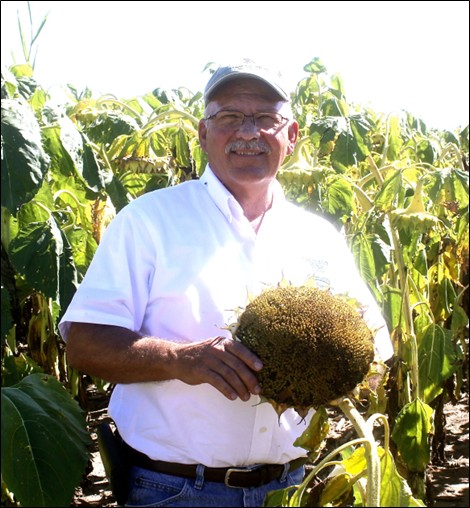
One of the most recognized and influential individuals in the High Plains sunflower community is retiring. Thirty-five years after joining the staff of Colorado State University, Burlington-based extension agronomist Ron Meyer is calling it a career as of May.
But that hardly means he is disappearing from the ag scene; far from it. “I will work part time on various projects in retirement,” Meyer says. Also, “some major agricultural companies have expressed interest in having me assist with on-farm agricultural research projects.”
Additionally, Meyer will continue teaching graduate students for Colorado State University. “Most grad students today do not have a farm background; but they are extremely smart, have lots of energy, and have a focus on helping people,” he says. ”I try to help them understand agriculture as both a business (employing IPM strategies) and a way of life.”
Meyer also remains a central figure on the Colorado Sunflower Administrative Committee (CSAC). He was part of the small group — mainly growers — who promoted the idea of a state checkoff organization back in the late ’90s, and it became a reality in 2001. Meyer has served as its executive director ever since. The main impetus behind the CSAC’s formation was to garner more funding for sunflower research, and that remains the top priority to this day.
Finally, on a personal level, “I plan to make time for fly fishing in blue medal waters in Colorado’s high country,” Meyer relates. “Spending more time with family is also a priority as my business schedule currently includes lots of travel.”
If that sounds like a busy schedule for someone heading into retirement, it doesn’t surprise those who have interacted with Meyer through the years and know him well.
“Ron Meyer has played a pivotal role in ensuring that sunflower remains a viable crop in many regions of eastern Colorado,” affirms Tom Kirkmeyer, Brighton, Colo., producer and current chairman of the National Sunflower Association Board of Directors. “Meyers’ extensive research has addressed crucial aspects of sunflower production. He has conducted valuable studies on herbicide applications, variety trials and insect management, as well as many other issues. These efforts have provided farmers with reliable information and practical solutions to common challenges associated with growing sunflower. His work has contributed significantly to maintaining the crop’s profitability, benefiting both producers and the sunflower industry in eastern Colorado and surrounding area.”
Lindsborg, Kan., grower and former NSA board president and chairman Karl Esping heartily concurs. “Getting to know Ron was truly a learning experience as we met at various meetings where Ron was the featured speaker,” Esping reflects. “For instance, at a Young Farmers & Ranchers meeting in Manhattan, Ron asked if I would help in the Q & A session. I was nervous, but his nature of presentation pulled me through. He helped me on that occasion as he has so many others in his career. He has been a great asset to this industry and High Plains agriculture in general.”
A native North Dakotan, Meyer split his youth between Minot and the family’s farm near Karlsruhe. “Dad was a carpenter, as he needed off-farm income. We’d live in town (Minot) during the winters; summers we’d move out to the farm,” he recalls.
After earning an associate degree in agricultural business from Bismarck State College with a wrestling scholarship (he was a North Dakota state high school champ), Meyer headed east to Fargo — and continued wrestling for North Dakota State University. He graduated from NDSU in 1979 with a B.S. degree in agricultural economics and minor in agronomy. In part because he had worked summers on an irrigated farm near Karlsruhe, the superintendent of the NDSU Carrington Research Extension Center, Howard Olson, hired Meyer to manage the center’s irrigation program.
A couple years later, Meyer and his wife, Linda, decided if he wanted to continue working in agriculture, he needed to get an advanced degree. Linda, an NDSU grad and social worker at Carrington, simultaneously wanted to earn a degree in elementary education. “So we moved back to Fargo.” The station held Meyer’s job, and they went to school winters, returning to Carrington during the summer. After earning his M.S. degree in agronomy from NDSU, Meyer continued to work at the Carrington center until being hired by Colorado State University in the spring of 1989 and moving 850 miles south to Burlington.
What prompted the move to eastern Colorado? “I wanted to work for extension,” he recalls. “I was 100% research at Carrington, and the [most enjoyable] part about that job was talking to farmers about what we were finding.”
After sending out his resumé to a number of institutions, the decision came down to offers from Iowa State University and Colorado State University. “The Iowa job was on campus, and it just didn’t feel like ‘home’ to me. This one (CSU) had a rural setting, and I loved living in a rural town.” There were some adjustments, however. “I still remember my first winter (coming to Colorado from North Dakota),” Meyer chuckles. “I didn’t wear a jacket, and the people here looked at me like I was nuts.”
The CSU agronomist has been a pillar of sunflower research and education across the ensuing 35 years. While his “official” position has encompassed five eastern Colorado counties (Kit Carson, Yuma, Washington, Sedgwick and Phillips), Meyer’s travels often carried him beyond those boundaries into much of Kansas, the Panhandles of Nebraska and Texas, and even back to North Dakota in January for the annual National Sunflower Association Research Forum. He has delivered sunflower presentations in 15 states and Kyrgzstan, a country in central Asia.
Having come from North Dakota and already being quite familiar with sunflower, Meyer saw solid potential for the crop in his part of the High Plains. But there wasn’t much local research to draw upon at the time. So he and CSU entomologist Stan Pilcher initiated sunflower trials.
“We answered a lot of basic questions about sunflower production in the High Plains with our on-farm trials,” Meyer reminisces. “In addition, sunflower was a new enough crop in the area that I had to plant some of our on-farm sunflower research into pinto bean fields. That shows the patience and support some of our growers had with my research requests.”
Date of planting studies came first. “We started planting in early May and finished up right before the 4th of July, having no clue which ones would be better,” Meyer reflects. Their studies showed the period between the third week in May to the second week in June to be the most suitable for eastern Colorado plantings. “The next question I asked was, ‘Do earlier plantings enhance or degrade yields?’ ” The answer was neither: May 1st plantings didn’t hurt or help, compared to latter May/first half of June. “But we did find that with planting dates of about June 10 or later, yields — and quality — started to drop.”
Meyer and Pilcher simultaneously discovered that June planting dates resulted in fewer insect problems (head moth and seed weevil), compared to earlier plantings. “And then, the later you planted, you had almost no bug issues.” Taking the insect factor into account narrowed that wide optimum-planting window down to the first couple weeks of June. The window likewise worked nicely for corn producers, who were done planting that crop by mid-May.
Additional early research looked at topics like seed size (smaller sizes emerged better in eastern Colorado’s dry, hot planting-time environment when it came to emergence percentages), plant populations (one category where the Northern Plains recommendations transferred well), planting depth (2.0 inches was best), fertility and weed control.
“We were full tillage back in the early ’90s around here,” Meyer remarks. “That’s another thing we found out: wheat stubble makes the best seedbed for any crop other than wheat. So the wheat-sunflower-fallow rotation really worked nicely with no-till.” The evolvement of planting equipment that cut through heavy crop residue was, of course, another big factor in the movement toward minimum- and no-till.
Annual sunflower variety trials became another key facet of Meyer’s work with this crop, as he and his team placed trial sites around the five-county area and beyond. “We didn’t have an experiment station close by, so most of my trials were performed on-farm. Some years I had 20 sites with various crops.”
As the CSU group developed more sunflower data and recommendations, they shared their findings with growers at winter meetings and summer field days. Struggling corn market prices at that time helped spark more interest in sunflower, as did the establishment of new High Plains outlets for the crop. Northern Sun (ADM) began crushing oil-type sunflower at Goodland, Kan., in the early ’90s. (That facility ceased its sunflower operation in 2023 and was sold to Scoular.) Colorado Mills, a sunflower crush plant at Lamar, opened in 1999. Also, the confection sunflower industry established itself in eastern Colorado and western Kansas and began contracting for acreage.
Colorado’s planted sunflower acreage climbed from 63,000 in 1991 to 270,000 in 1999. It dropped to 100,000 as of 2006, way down to 46,500 in 2014 — and popped back up to 90,000 in 2018. (The 2025 number was 39,500, according to USDA.)
Meyer left his CSU position for three years (2007-10) to become a local field advisor for Monsanto. The ability to remain in Burlington was a major consideration in taking that job, and he enjoyed the new challenge. But a reorganization within Monsanto meant he would have to leave the area to stay with the company. Ironically, CSU had never filled his five-county extension post during his absence, and the university invited Meyer back. He accepted without reservation; no retraining required. “I opened my office desk drawer, and the pencils were right where I had left them three years before!” he quips.
Meyer’s research projects with sunflower have continued to encompass a variety of production topics in more-recent years. “My assignment with Colorado State University also involves other crops such as winter wheat, corn, sorghum, forage crops and specialty crops (various beans, pop corn, quinoa and others),” he advises. With sunflower, as noted previously, “initially we needed to discover some early production strategies such as ‘what is the planting window.’ Since then, research has involved testing improved varieties, researching fertility, adding biologicals, micronutrients, fungicides and insecticides, and testing various herbicides, among other production topics. “All this research was accomplished on-farm at various eastern Colorado locations with innovative farmers who allowed me on their farms.”
Sunflower production in Colorado has clearly evolved over recent years, Meyer affirms, even with the fluctuating acreage. “At one time, eastern Colorado produced lots of confection acres. Our elevation is 4,000 to 5,500 feet above sea level, and the environment allows confection sunflower to produce large-sized seeds which were in demand from some European countries. Most of these were then exported. “However, world demand shifted, and today the confection market is much reduced locally.
Colorado growers currently contribute a significant market share for the birdseed industry, Meyer notes, and that has evolved into a steady outlet for oil-type sunflower — particularly when coupled with the needs of the Colorado Mills crush plant at Lamar. “As a result, eastern Colorado now produces mostly oil-type sunflower.”
As to sunflower production challenges as of 2025/26, achieving a solid plant stand remain toward the top of the list for many growers, the CSU agronomist observes. “This was especially true with confections, as the seed hull is much larger. Our research results suggested that when planting sunflower, plant the smallest sized seed possible. That find worked. Today, planting oil-type sunflower makes stand establishment much easier. Oil-type sunflower seed is smaller in size and easier to achieve targeted stands.
“Additionally, thanks to efforts by the National Sunflower Association we can better address broadleaf weed control strategies in sunflower. While grasses emerging in sunflower have not been much of a challenge to address, kochia and Palmer amaranth were,” Meyer says. “However, the NSA made these weeds a priority, and today we have multiple herbicides labeled that make managing these broadleaf weeds easier (sulfentrazone and Zidua, Clearfield, Express and others).
“As a result, both of these earlier-mentioned sunflower production challenges now have better answers.” Future challenges include keeping IPM strategies current and continue to monitor pests for tolerance and resistance to production inputs” Meyer believes. “Have a Plan B ready when that happens.”
Ron Meyer’s outlook for sunflower in the western High Plains remains positive as he moves into retirement. “The new [high-oleic] oil is healthier and has a longer shelf life, which I believe will continue to have a positive demand by consumers” he affirms.
“Research results indicate that sunflower oil may also lower cholesterol.
“Sunflower meal is a continued favorite from livestock producers, and so there isn't much waste from this crop,” he adds. “Even sunflower stalks left standing after harvest serve as a ‘snow fence’ capturing winter moisture.”
Not surprisingly to anyone who knows him, Meyer’s favorite part of his CSU job involved working with farmers on their land, discovering production information that could enhance their and others’ livelihoods.
Now, after a 40-plus-year career in agricultural academia, speaking at 600 meetings, 210 publications, approximately $1.6 million in funded grants ($11 million with partners), and a 15-page resume, “I plan to quietly exit into the next journey,” Ron Meyer affirms.
Quietly, perhaps, but not without purpose — and, as well, not without leaving behind an impressive legacy across the High Plains agricultural community. — Don Lilleboe