* By Febina Mathew(1), Samuel Markell(2), Robert Harveson(3), Megan McCaghey(4), Peter Kovacs(5) & Karthika Mohan(6)
Phomopsis stem canker continues to be a major issue for many sunflower growers in Minnesota, North Dakota and South Dakota. Farmers commonly see stem lesions, wilting and pith degradation that lead to lodging and yield loss.
Researchers studied the disease in 75 field trials from 2009 to 2024 to understand how much yield loss is linked to disease severity.
The following are several questions that university plant pathologists commonly receive from sunflower producers regarding this disease, along with brief answers. Producers seeking additional information pertaining to Phomopsis identification, research and management are encouraged to contact their respective university specialists.
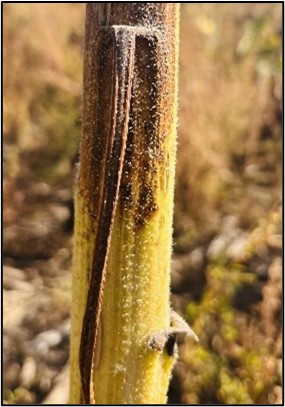
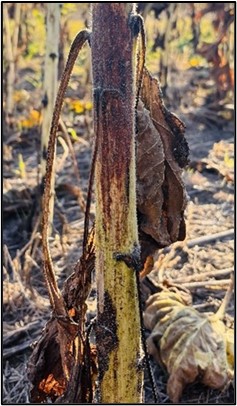
Stem lesions from Phomopsis infections, South Dakota 2025.
(Photos: Febina Mathew) |
 |
 |
Q: “My sunflower doesn’t look good this year — stems are weak, and plants are lodging. How much yield might I be losing?”
A: Based on the 75 field trials, researchers estimated that each 1% increase in Phomopsis stem canker severity causes about an 18-lb per-acre yield loss in low-yield environments. If the field is already stressed (weather, soil, etc.), Phomopsis stem canker will take even more yield off the top.
Q: “My fields usually yield okay. If I see stem canker, should I be worried?”
A: Yes. Even in moderate-yield fields, Phomopsis stem canker still reduces yield. In these fields, every 1% increase in DSI lowered yield by about 10 lbs per acre.
Q: “I’m in a high-yielding field — good soil, good moisture. Will stem canker hurt my yield?”
A: In high-yielding environments, Phomopsis stem canker showed little to no effect on yield in the research trials.
Q: “I just want one simple number. On average, how much yield do I lose per 1% DSI?”
A: Across all 75 trials, each 1% increase in Phomopsis stem canker severity reduced yield by about 10 lbs per acre on average.
Q: “If I spray fungicide, can I expect better yields?”
A: Yes. Across the 12 location-years, fungicide treatments significantly increased yields compared to the no-fungicide control.
Q: “Which fungicide program gave the best yield?”
A: The highest yield came from Pyraclostrobin (Headline) at R1 (miniature floral head is formed on the plant), followed by Fluopyram + tebuconazole (Luna Experience) at R6 (post flowering).
Q: “Does timing matter?”
A: Yes, timing mattered. Fungicide applications, at R1 and/or R6, provided greater yield when compared to no-fungicide control.
* (1) Associate Professor, North Dakota State University
(2) Professor and Extension Plant Pathologist, North Dakota State University
(3) Professor and Extension Plant Pathologist, University of Nebraska, Panhandle Research and Extension Center
(4) Assistant Professor, University of Minnesota
(5) Associate Professor, Precision Agriculture Cropping Systems, South Dakota State University
(6) Graduate Research Assistant (Mathew lab), North Dakota State University